
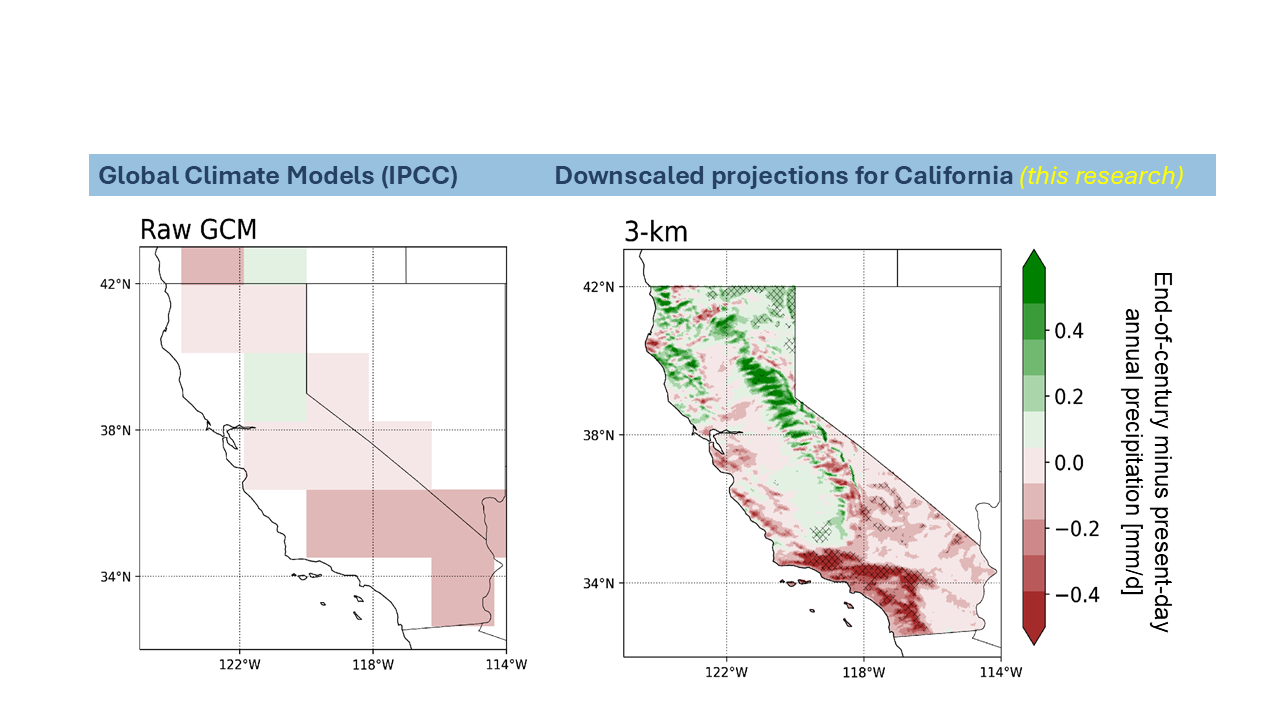
As recognized in the California Public Utility Commission’s Adaptation Rulemaking (R.18-04-019), planning for a climate-resilient electricity sector requires data that project how climate and weather may evolve. Because global climate projections are produced at coarse resolution, they must be downscaled to capture California’s complex topography and varied regional climate. This research project delivers one of the world’s most advanced regional climate projections datasets, providing California’s investor-owned utilities with fine-scale, state-of-the-art data to support vulnerability assessments and adaptation planning.
By applying cutting-edge downscaling approaches to the latest generation of global climate models and engaging energy sector stakeholders, the project produces an extensive suite of projections tailored to California’s adaptation needs. The dataset includes high spatial (3 kilometer) and temporal (daily to hourly) resolution projections, produced by two downscaling approaches: dynamical and hybrid-statistical. The dynamical approach provides sub-daily to daily projections of more than 30 variables from eight models under one climate change scenario. Because electricity sector modeling requires climate information that extends beyond California’s borders this approach also includes lower-spatial resolution projections over the western United States. The hybrid-statistical approach generates daily projections of critical climate variables for many models under three different climate change scenarios over California. A subset of this data was further used to produce hydrological projections, portraying variables essential for assessing hydrological climate risks that affect hydropower infrastructure and operations. The project also developed sea level projections at selected coastal and San Franciso Bay-Delta sites, capturing hourly variation and multi-decadal sea-level rise scenarios. Given the large volume of data, a reduced set of projections was identified as a practical starting point. By providing a rich suite of high‑resolution projections and a streamlined subset for general use at the exploratory stage, the project meets a critical need for locally relevant climate information that supports California’s investor-owned utilities, state energy planning and regulatory agencies, California’s Fifth Climate Change Assessment, and applied climate research.
The data delivered by this project have been made available on Cal-Adapt: Analytics Engine (https://analytics.cal-adapt.org/). Documentation about the data is available on the California Energy Commission’s Climate Data and Analysis Working Group (C-DAWG) website (https://www.energy.ca.gov/programs-and-topics/topics/research-and-development/climate-data-and-analysis-working-group-c-dawg) under the Data Justifications Memos and Supporting Information to Climate Data Summaries pull-downs.
Research described by this agreement was administered by CEC with ratepayer funds from the Electric Program Investment Charge (EPIC) under the auspices of the California Public Utilities Commission (CPUC). This agreement’s Final Report describes original, energy-related research that contributes to California’s Fifth Climate Change Assessment (Fifth Assessment). The Fifth Assessment comprises a broad portfolio of research and synthesis reports that address California-specific research needs and knowledge gaps related to climate change. To ensure scientific rigor, Fifth Assessment research was peer-reviewed. This research effort was peer reviewed through external (journal) publications.
Report Information
CCCA5-CEC-Energy-EPC-20-006
Lead Authors: Julie Kalansky, Ph.D., Daniel Cayan, Ph.D., David Pierce, Ph.D., Stefan Rahimi, Ph.D., Ben Bass, Ph.D., Peter Yao, Sam Iacobellis, Ph.D.
Coordinating Commission Agreement Manager: Martine Schmidt-Poolman, Ph.D.