
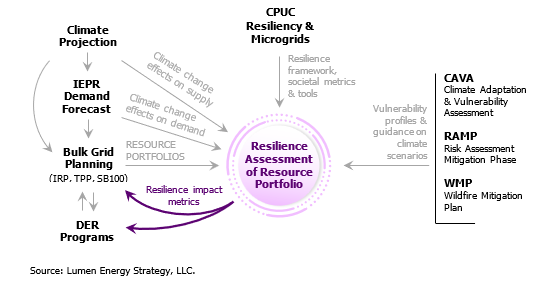
The WARP to Resilience study supports three key efforts towards electricity sector resilience: (a) build tools and science-based research for holistic energy decision-making; (b) improve understanding of climate- and weather-related risks and resilience options; and (c) integrate climate readiness into electricity system operations, tools, and models.
Institutional barriers include (a) no common definition of resilience or specific resilience evaluation metrics; (b) insufficient representation of climate-driven risks in grid planning models; (c) planning models not structured to evaluate resilience; and (d) no assessment of the resilience outcomes of alternative resource portfolios.
The project team navigates these barriers, first with (a) development of a resilience evaluation framework and metrics applicable to grid planning; (b) development of a data library of climate-informed weather variants and metrics for use in hourly time series grid planning models; and (c) parameterization of planning assumptions for electricity demand, supply, and delivery to each weather variant per planning year.
With these advancements, the project team builds a prototype resilience evaluation model that estimates detailed disconnected load and lost load outcomes due to weather-driven bulk grid and to distributed grid failures. The model is designed to utilize and enhance California’s existing integrated resource planning model architecture, by evaluating optimized resource portfolios for resilience impacts, and by feeding back information on hidden weather vulnerabilities and demystifying the performance of distributed resource solutions. The model can support coordinated resilience planning decisions across a range of state proceedings and local initiatives, tying together climate research, bulk grid planning, distributed grid planning, and local investment decisions.
Model results demonstrate untapped benefits of whole-grid, customer-oriented, resilience planning. The project team quantifies and inspects California’s resilience gap, calculates how resources are likely to address it, and demonstrates how a large portfolio of local resources can be operated to serve ratepayers while also serving their communities.
Research described by this agreement was administered by CEC with ratepayer funds from the Electric Program Investment Charge (EPIC) under the auspices of the California Public Utilities Commission (CPUC). This agreement’s Final Report describes original, energy-related research that contributes to California’s Fifth Climate Change Assessment (Fifth Assessment). The Fifth Assessment comprises a broad portfolio of research and synthesis reports that address California-specific research needs and knowledge gaps related to climate change. To ensure scientific rigor, Fifth Assessment research was peer reviewed. This research effort was peer reviewed through an editorial board established for the Fifth Assessment, which also served (where applicable) to support appropriate representation of the practitioners and stakeholders to whom each report applies.
Report Information
CCCA5-CEC-Energy-EPC-22-001
Lead Authors: Cevat Onur Aydin and Mariko Geronimo Aydin
Coordinating Commission Agreement Manager: Mithra Moezzi, Ph.D.